Our planned laboratory brings together scanning probe instruments, programmable control, and machine learning. Instrument choices will follow the scientific measurements each project requires.
Instrumentation roadmap
The capabilities below describe planned purchases and development priorities. Specific instrument models, installation dates, and operational availability have not yet been announced.
Planned capability
Atomic-scale fabrication and characterization
A scanning probe platform for local structural and electronic measurements, with a path toward automated atomic manipulation.
Scientific purpose: connect controlled changes in atomic structure with the resulting material response.
Planned capability
Automated scanning probe microscopy
Flexible imaging and spectroscopy with programmable acquisition, instrument tuning, and repeat measurements.
Scientific purpose: explore local functional response and test whether automated measurements are reproducible across samples and settings.
Planned capability
Connected characterization tools
Complementary measurements linked through consistent sample identifiers and experimental records. The specific methods will depend on the materials and physical questions.
Scientific purpose: compare observations from different probes and connect local measurements with broader material behavior.
Development priority
Software for closed-loop experiments
Instrument interfaces, experiment planning, data analysis, and records that connect an experimental decision to its measured outcome.
Scientific purpose: let models guide experiments while preserving the information needed to inspect and reproduce each result.
Instrument development
Digital twins for adaptive microscopy.
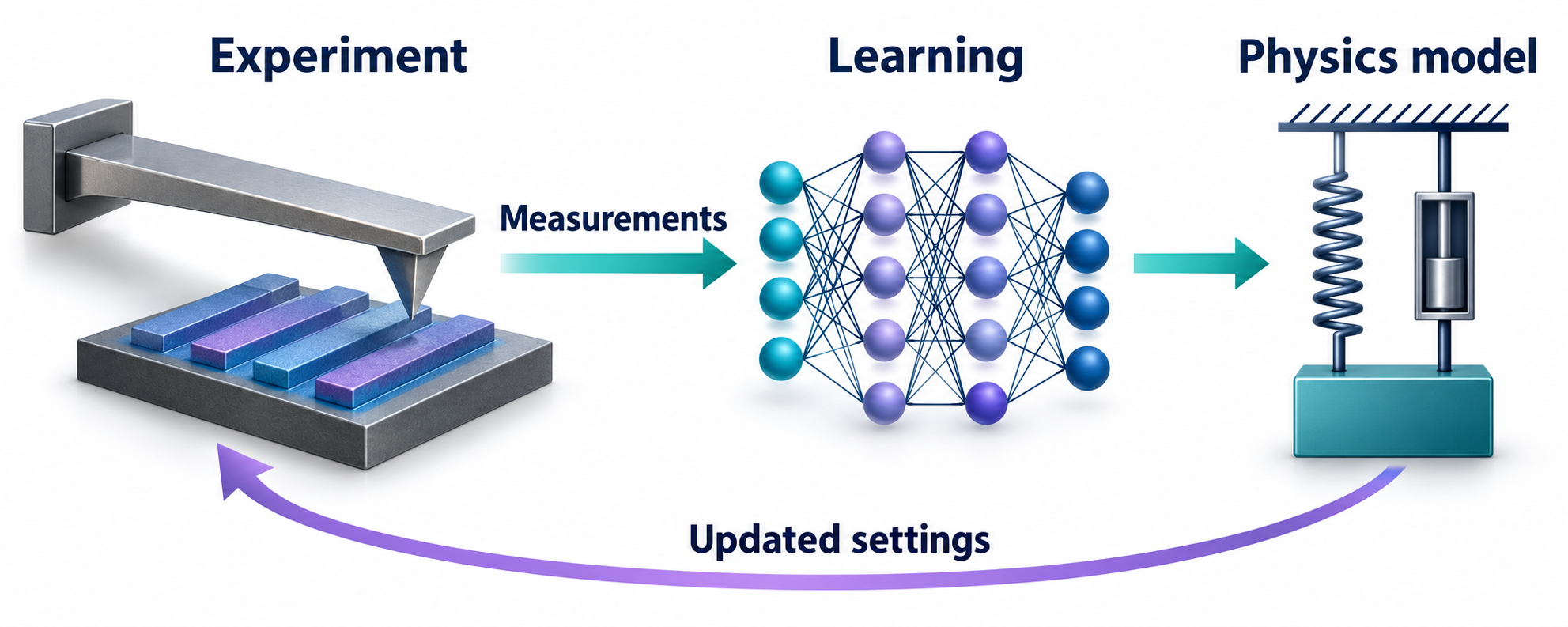
Connect physical models of instrument response with learning from measurements, then use the updated model to guide experimental settings.
AI-generated conceptual schematic, based on Richard Liu’s digital-twin research diagram. The mechanical model is a simplified illustration.View full-size schematic
The planned development will need to account for the probe, tip–sample interaction, and controller dynamics. The schematic illustrates the feedback structure of this approach.
Existing open-source work
AESPM
A Python interface for local and remote control of Asylum Research scanning probe microscopes.
Programmable access allows researchers to connect instrument operation with analysis and experimental decisions. AESPM is part of Richard Liu’s prior work on automated scanning probe microscopy.
Our development priorities extend this approach toward connected fabrication and characterization workflows.